CURBING FOOD LOSS AND WASTAGE THROUGH FOOD PROCESSING AND PACKAGING

DPat Foundation is constantly exploring ways by which topics of grassroots economic growth can be brought to the front burner for public discourse and to the attention of stakeholders for positive actions. In this feature piece, we look into how as many cottage food processing and packaging industries as possible can be birthed across the country. This, we believe, will curb food loss and food wastage and also engender sustainable food security, employment generation and economic growth. .

Food loss refers to food that is discarded or LOST along the journey from production, harvest, post-harvest, storage, transportation and processing stages thereby failing to reach the retail and consumer stages. Food waste, on the other hand, refers to discarded or WASTED food at the retail and consumer levels. Both situations are due to inefficient or inadequate transportation, processing and storage facilities or systems. This is a stack reality even in the face of almost a billion people suffering from hunger and malnutrition everyday globally.


The Food and Agricultural Organisation (FAO) reports that approximately one-third of food from farm at harvest stage to final consumption is either loss or wasted throughout the supply chain. Thus food loss and wastage is estimated to 1.3 billion tons amounting up to 1 trillion Dollars annually. Food loss and wastage (FLW) or post–harvest losses are reported to occur more in Sub-Saharan Africa (SSA) than other parts of the world.
Bringing the statistics closer home, the World Food Programme (WFP) reported that “Conflict and insecurity, rising inflation and the impact of the climate crisis continue to drive hunger in Nigeria – with 26.5 million people across the country projected to face acute hunger in the June-August 2024 lean season.” This is a staggering increase from the 18.6 million figure released at the end of 2023. An earlier report by the United Nations released in 2021 revealed that food wastage in Nigeria per citizen is the highest in Africa. According to the report, Nigerian trash at least 189 kilograms of food every year, amounting to a total of 37.9 million tons of food annually.


Perishable goods like tomatoes, cassava, potatoes, mangoes, water melon, pawpaw, pears etc., suffer most from FLW in Sub-Saharan Africa, with Nigeria as our focus. If sizable amounts of food that are lost or wasted throughout the supply chains in the agricultural and food sector are to be efficiently (i.e., timely and safely) transported from point of harvest to the final consumers with each stage in the value chain adequately maximized, food security and better living standard can and will be cheaply achieved nationwide.
Measuring progress made in mitigating against FLW

Food processing, which is one of the primary steps towards food preservation, is an act of working on food produce to a point that it can stay for a much longer period than it would in its primary production state without spoiling or losing value. Food can either be fully processed (e.g., cassava to garri) or semi-processed (e.g., cassava to lafu). Food preservation is a major outcome of food processing. Storage of processed food (“banking” food for feature consumption) becomes easier at its processed state.


Packaging is a major value addition in addition to processing and storage values. Packaging helps to brand, scale, advertise and present our local food for both local and international markets. All this makes seasonal foods available all year round and the more of a particular food we have all year round, the more affordable it becomes.

Achievements, however, have been made in our various agricultural and food research based institutions and agencies in the areas of food processing technology. Organisations like FIIRO, IITA, etc., have make a lot of progress in their research efforts into how local foods can be processed, preserved, stored and packaged to last all year round with their qualities intact. Through the efforts of some of these research institutions, we can now bake bread using purely cassava flour as complete substitute for wheat flour. Poultry and ruminant feeds can now be made out of cassava peels as also many other local produce can now be processed into forms that provide great value additions. The list goes on and on.

Our local entrepreneurs at micro and small scales on the other hand are cashing in and many have taken the challenge to process and package so many of our local foods for local and global markets. As you read this there are so many brands of Bambara beans flour, soya beans flour, beans flour, potato flour, potato garri, plantain flour, date powder, date syrup, garlic power, ginger powder, onion powder, peanuts butter, coconut oil, cassava flour and a whole lot of others.


However, the scale and rate at which most of these economic and entrepreneurial activities are going is too slow, too low and too inadequate to mitigate adequately against FLW or post-harvest loss to engender the desired economic growth and generate adequate employment. Our government still have a great deal of works to do in this direction as so much vacuum still exist to be filled and so many loose ends need to still be tightened to adequately mitigate against FLW.

Obstacles to progress

A number of obstacles exist on the paths to solving FLW. These obstacles include:

  1. Absence or inadequate information available to small holder farmers from relevant bodies due to absence or poor communications or even training system that should bridge the knowledge gap.
  2. Poverty and lack of fund on the part of nano, micro and small scale entrepreneurs and enterprises. This prevents them from engaging in food processing and packaging on a much larger scale than is presently obtainable.
  3. Absence of technical skills or expertise on the part of nano, micro and small entrepreneurs as far as food processing, preservation and packaging is concerned.
  4. Lack of a robust, sustainable and all inclusive national food supply chain network policy
  5. General systemic corruption.

Roadmap to progress (Our Recommendation)

The problem and its effects face all of us daily. We see unsold and wasted food every day in our local markets where spoiled foods are thrown into gutters and dustbins everywhere due to lack of proper preservation. This is in addition to those that could not get to the market due to lack of good facilities for transporting and storing and preserving them. It will take a compassionate and dispassionate resolve on the part of policy makers to embark on this journey to mitigate against these unnecessary colossal wastes while hunger ravages the citizens. An unflustered political will on the part of all government stakeholders in conjunction with private stakeholders is required to create an uncluttered national roadmap towards eliminating or reducing FLW and consequently bringing about food security and employment.

As an NGO that feels the pulse and pains of the people at personal and grassroots levels, we recommend a simple roadmap towards solving FLW to better the lots of small holder farmers, nano, micro and small scale entrepreneurs for mass employments opportunities for our ever-increasing unemployed and under-employed youths. Below are 5 points agenda highlighted by DPat Foundation to through which to reach this goal.


  1. Collaboration between relevant MDAs and private organization to come up with a blueprint on national food supply value chain. With endorsement of the presidency this can become the guiding policy for all farmers, middlemen and MSMEs in food supply value chain right from harvest stage to consumption stage. The main objective of the blue print being the curb food loss and wastage through food processing, preservation and packaging.
  1. Training in food processing and packaging in partnership with NGOs like DPat Foundation and other private organizations who have years of experience in empowering entrepreneurs.
  1. Such food processing and packaging skills training should be provided for nano/micro and small scale entrepreneurs to meet global best practice – national and international standards like SONCAP, MANCAP, ISO etc.
  1. Adequate funding facility should private to the trainee so they can operate at expanded scales thereby generating better income and jobs while mitigating against FLW.
  1. The blueprint should be subject to periodic reviews to meet new or emerging challenges.

Measuring Progress Going Forward (meeting our objectives).

In conclusion, how do we know when our objectives, namely, curbing food loss and wastage through food processing and packaging is achieved? The following indices would help measure the progress if such a scheme or blueprint is formulated and implemented.

  1. Increased food security through the availability of seasonal foods all year round.
  2. Food affordability due to less food loss and food wastage.
  3. Better or improved income level for small holder farmers.
  4. More employment opportunities for our women and youths
  5. Increased income and forex from local cottage food packaging industries.
  6. Increased gross domestic products (GDP) in the food and agric. Sub-sector.

READ MORE

SECURING THE FUTURE OF OUR CHILDREN AND YOUTHS

“It takes the whole village to bring up a child,” says an African proverb. If you are hearing or reading this proverb for the first time or for the first time in a long while it is because the culture that drives that proverb is fast fading out of the fabrics of our society. In bygone days it used to be believed that “Every child is your child.” Today, however, as far as a child is not biologically our own, he or she is not our responsibility.


The plights of children today are getting worst by the day because of the weakening cultural values. Child neglect and its resultant effects, namely, juvenile deliquesce seems normal. Many see this evil as something they can do nothing about; yet most of us can do something to contribute towards it elimination or reduction.  Many children who have either lost one or both of their parents or whose parents are not financially capable of sending them to school are left, you my say, to themselves. But in reality, they are left in the hands of unscrupulous individuals who find them ready criminal recruits

PROJECT60 to the Rescue

However, DPat Foundation, through its founder/president, Elder Mrs. Patient Ardey (JP) insists on changing this ugly narratives by floating PROJECT60. As though she is practically echoing the saying of a wise man by name Edward James Olmos who once said that “Education is the vaccine of violence.”


PROJECT60 is the scholarship arm of DPat Foundation designed to contribute to the elimination, or at least, the reduction of the menace of out of school children in the society. PROJECT60‘s ultimate goal is to come to point where it can be picking children from the street and send them to the school, sponsoring them all through primary to secondary school levels.

The latest reports on out-of-school children (OOSC) in Nigeria by the United Nations Educational, Scientific and Cultural Organisation (UNESCO) says that the estimated figure of out-of-school children presently in Nigeria is 20 million. Similarly, the latest global data on out-of-school children in early 2023 by the United Nations Children Emergency Fund (UNICEF) also estimated that the total number of out-of-school children in Nigeria is over 20 million, 69 per cent of which is shared by the northern part of the country.


In view of this fearful statics and looming danger staring us as a society and as a nation in the face, Founder/President, DPat Foundation, Elder Mrs. Patients Ardey, with the co-operation and blessings of the Chief and community heads and elders of Ibua2 in Gwagwalada Area Council of the FCT, launched out by picking over 60 children from within the said community to be trained through primary school starting from the 2023/2024 academic session. This is the first batch to be followed by subsequent batches in subsequent school academic sessions.

Empowering Women, the Girl-Child and Youths

Four over four decades, Elder Mrs. Ardey worked tirelessly to ensure that women and young people are not left as victims of adverse socioeconomic situations. She has through DPat Foundation helped to empower women, girls and youths with  trade skills and also helped to connect many of them to financial facilities like loans and grants from reputable government and private bodies to enable them start or expand their trades.


Endorsement, Partnership and Awards

In the cause of the years, Dpat Foundation has enjoyed the endorsement and partnership as well as working relationship with several government ministries, departments and agencies (MDAs). These include Ministry of Women Affairs, Ministry of Agriculture, National Directorate of Employment (NDE), Bank of Agric (BOA), Bank of Industry (BOI), Abuja Enterprise Agency (AEA) and many others. The founder and president has also received several awards from reputable public and private bodies.

Partner With Us

The financial responsibilities involved in carrying out these tasks are overwhelmingly challenging. The responsibility of making the future safer extends to making sure children today are inoculated with sound education. All hands must be on deck to stem the alarming tides of the dangerous future consequence of the current wave of out-of-school children.


We invite you to be part of this ongoing noble project. Your partnership will go a long way in picking a child out of the street and giving him or her the desired future.


READ MORE

TESTIMONIALS – My Journey with DPAT Foundation By PATIENCE OIZA FACHE

Patience Oiza Fache

My journey with DPAT Foundation started in 2009, when I decided to learn tailoring and fashion designing with the foundation. After he specified period, I got admission into the university. After completing my school programme and serving with NYSC, I started a career in fashion design. In the world of fashion design, were creativity is mandatory, finding a guiding light can be transformative. For me, that beacon of guidance came in the form of the DPAT Foundation, an NGO dedicated to empowering women and children at the grassroots.

Mr. Chimezie Noble, FCT State Coordinator of National Directorate of Employment inspecting dresses made by a beneficiary of DPat Foundation at an exhibition stand during a symposium on nano enterprises organized by DPat Foundation.

Through collaborative projects and initiatives, the foundation has helped me in several ways, I have gained mentorship by the president, Elder Mrs. Patience Ardey, I learned to market and advertised my business through many platforms made available by the foundation, I have also gotten Grants from renowned government agencies.

Designs by Patience Fache
Patience and others Modelling some of her designs.

The president of the foundation has fought tirelessly to break down barriers and create opportunities for those who have been marginalized by society. Through her leadership, DPAT Foundation has initiated numerous programs aimed at education, healthcare, economic and social empowerment. Witnessing her passion and determination first hand has fuel my own desire to contribute meaningfully to the world.

  • PATIENCE OIZA FACHE
READ MORE

SIMPLE BOOK KEEPING FOR NANO AND MICRO ENTERPRISES

BKPING

Book keeping is an act of keeping business financial records. It is the means by which you capture your day-to-day business transactions. It is the means by which you give daily account and reports of your daily business transactions. It helps you understand the behaviour of your business, the customers and the market. Although book keeping is an important aspect of accounting, you do not need to be an accountant to understand and apply simple basic book keeping in your business’s financial management as a nano and micro scale entrepreneur. In this brief write up you will understand book keeping in its most basic form and put what you learn to immediate use.


Why bookkeeping?

Why do you need to understand and apply book keeping skills? No business can be said to be well organized if its financial records are messed up or mixed up. Your business may be growing but without good financial records progress is difficult, if not impossible, to trace. Many entrepreneurs claim they know the business too well to know when they are making profits or losses, but many such businesses may be making losses with mental calculations but may in fact be making profits that are actually leaking away without their knowledge if traceable records are not kept.


A business may be making losses not because the products or services are not selling, but because the sales are not properly juxtaposed against costs and expenses. Proper record keeping therefore helps you trace where the monies are coming from, how they come and how they go and for what. Book keeping, therefore, records, tells and traces your financial history.


Let us look at some more other merits of or reasons for book keeping.


  • Book keeping shows the health and wealth of your business per time
  • Book keeping shows how much money your business receives
  • Book keeping shows how much money your business pays out
  • Book keeping shows how much money your business owes
  • Book keeping shows how much money your business is been owed
  • Book keeping helps you control how much money your business spend
  • Book keeping helps you identify leakages in your finances before it gets too late
  • Book keeping enable you plan, organize and prioritize ahead
  •  

Types of Records to be kept in Book Keeping

There are different records that must be kept in as you carry out your business activities. These include:

  • Purchase record – this is the records of purchases of your goods. It is also known as purchase journal. This may be purchases of raw materials (if you produce or manufacture your items) or the purchases of ready-made items/products (if you buy and sell). Ensure that your purchases are invoiced where possible and that purchases made on credit are recorded here.
  • Stock record – this is the record of your raw materials that will be used to manufacture or produce or fabricate what you sell or supply. These may be raw food items and ingredients (if you operate restaurant, for instance) or other materials like leather, soles, threads etc., (if you manufacture shoes or other leather products, for instance).
  • Inventory record – this is the record of items that are now ready to be sold. This may be the already made product which are already displayed for sales. In fact, any of your used tool or equipment that you no longer use but need to sell and raise cash from should be recorded in the inventory also.
  • Sales records – this is the records of your daily sales. Ensure that sales made on credit are recorded here.
  • Income record – this records all monies that enters into your business. This takes care of cash inflows.
  • Expense record – this is also called expenditure records and it records all expenses or cash outflows from your business.

Getting started

As said earlier, this is just a simple or simplified approach to book keeping for nano and micro enterprises for immediate application. As your business expands in volume or advances in scopes a more expanded and advanced approach can be applied. Here below is how to kick-start and keep a very simple daily business transactions records.

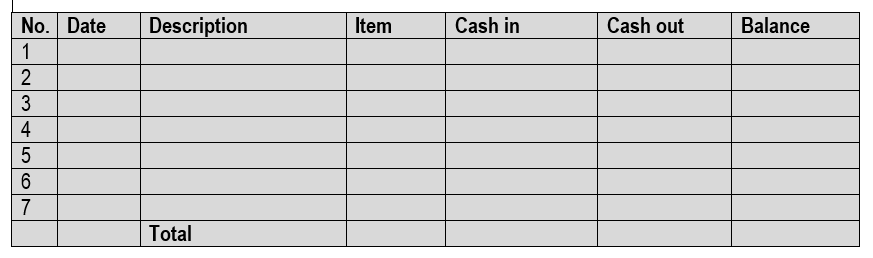
For simple start, get a note book and rule the pages as shown below. This example shows basic income and expense record.


Always remember that paper does not lie. If you fail to record your transactions you will forget them tomorrow. Even old women who cannot read and write make marks on the walls to remind them of transactions. Let every day’s transactions go down on record. Starting with date, describe the transaction under “Description” (you may include quantity and rate in the “Description” column or rule two more columns for them) then name the item under “Item”.


Enter the amount under “Cash in”. If it involves an amount you are spending from, it is helpful to use the first roll to enter the amount and term it as “brought forward” or “B/F” under “Description.” The amount under “Cash out” is to be subtracted from the amount under “Cash in” then the difference is entered under “Balance”. All these are added up vertically from top down to determine the total of each. Please, note that the rolls can be as many as your book can contain.


Detailed practical training awaits you at DPat Foundation secretariat.

READ MORE

GIANT STRIDES IN GRASSROOTS AND RURAL WOMEN EMPOWERMENT

Since Nigeria as a nation assumed self-governance after obtaining independence from its colonial masters several efforts have been made by its government to reach the citizens at the grassroots levels. A major effort in this direction is the creation of the third tier of governing system, namely, the local government, designed to bring governance and its dividends closer to the grassroots. Besides this there have being other federal ministries, departments and agencies (MDAs) that have been created and designed to make government closer and accessible to rural people.


Government initiatives and other pet projects by the nation’s past first ladies and states governors’ wives have also been floated to bring about poverty alleviation through skills empowerment for self-employment, provision of farm inputs and facilities to farmers, provision of trade equipment such as agro-processing equipment at subsidized rate, provision of educational materials and facilities for schools and pupils/students in rural areas to mention a few. However, many of these efforts, as noble as they were and with so many recorded impacts, have been plagued with numerous challenges. As a result and with the prevalent economic situations, the grassroots people are denied of so many assistance they should have received for their socioeconomic well being.

On its part, DPat Foundation since its inception has remained on course in the discharge of its duties with a resolve to bridge this gap as a conscientious not-for-profit organization. It has consistently reached out to rural women, empowered them with relevant trade skills, organized and linked them with government agencies that have made financing facilities available to them to carry on the trades they were trained on by the foundation itself. DPat Foundation has a union of co-operatives which is the umbrella of all the numerous co-operatives that have been formed by the organization in the quest to cater to the financial empowerment needs of the women and youths it trains

Thus in several rural communities today, especially around the FCT and particularly within Gwagwalada Area Council, the presence of the foundation is readily felt among the people. Most of these are women and youths who have received grants, loan facilities and farm inputs via the efforts of DPat Foundation. Exhibitions have also been organized severally with guests from the National Directorate of Employment (NDE), the Bank of Industry (BOI), Bank of Agric.(BOA), Abuja Enterprise Agency (AEA), Ministry of Woman Affairs, Agricultural Development Project (ADP) to mention a few, in attendance. These exhibition were to showcase the works of the women and youths trained by the foundation.


DPat Foundation is also visibly and actively involved in academic empowerment for children. Through its scholarship scheme called PROJECT60. The Foundation is currently sponsoring over sixty children from primary through secondary school. This project is meant to help reduce the menace of out of school children within the FCT, especially the Gwgwalada Area Council. Although, the foundation on its own cannot single-handedly curb the menace of out of school children, it hopes to contribute its own quotas to the solution.

The founder/president of DPat Foundation, Elder Mrs. Patience Ardey (JP) is passionate about this project just like she is about the others. The foundation, however, is in dire need of partners and donors to help push this scheme forward because sponsoring these children has being a herculean task for the foundation. The joy of knowing that crime is being curtail and the future of these children is being secured is the major driving force behind the scheme. We invited good hearted Nigerians to join forces with us through financial donations and partnership in bringing this vision to pass.

Children in communities of Gwagwalada Area Council is been focused on at this early stage of the scheme, in subsequent scholl sessions, we hope to extend the scope to other parts of the FCT, north central and the nation ant large.     Please, join us.


PROJECT60 (the scholarship scheme) is not the only area for which partners and donors are needed by the foundation. Other areas like women, girl-child and youths empowerment are equally crucial areas that need the collaborations of individuals, organizations, institutions and even international bodies to carry on.


READ MORE

CASSAVA PROCESSING AND GARRI PRODUCTION IN OGOBIA-UGBOJU, BENUE STATE – Observations and Recommendations by DPat Foundation (NGO)

Cassava farming and processing is at the center-stage of economic and grassroots industry in most towns and communities in Benue state. In places like Ogobia and other communities in the state, for example, attention are shifting from the age-long yam farming the people of the state are historically known for to cassava farming due to its current high demands for processing into staple foods like akpu,  lafu and most especially, garri.


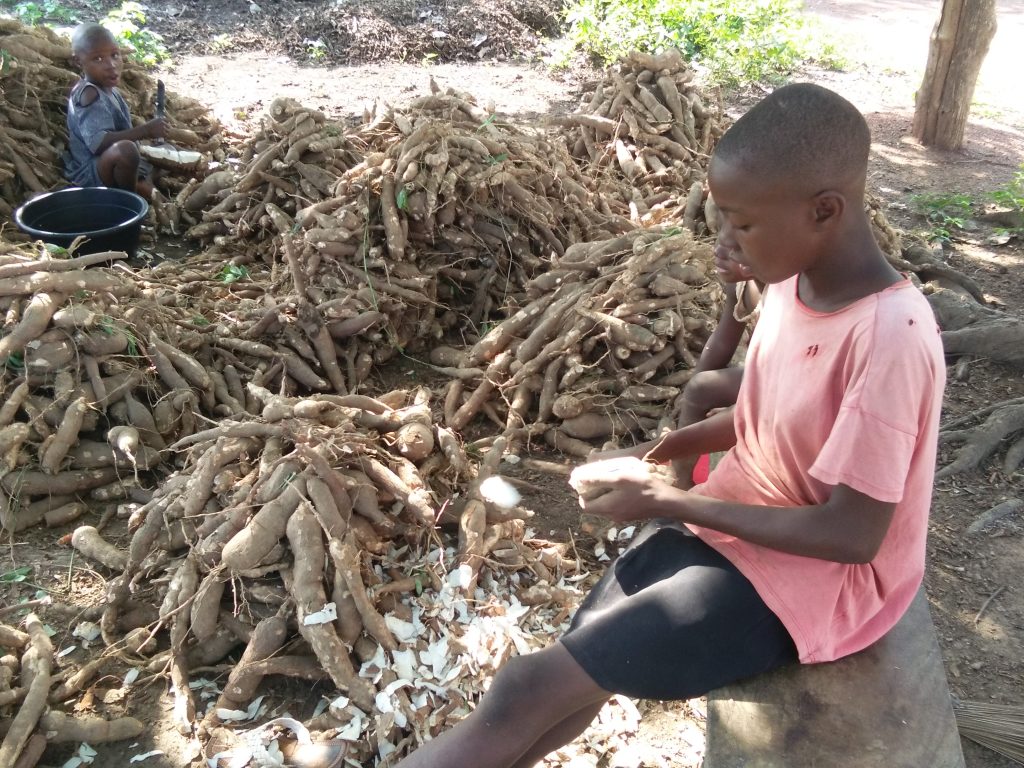
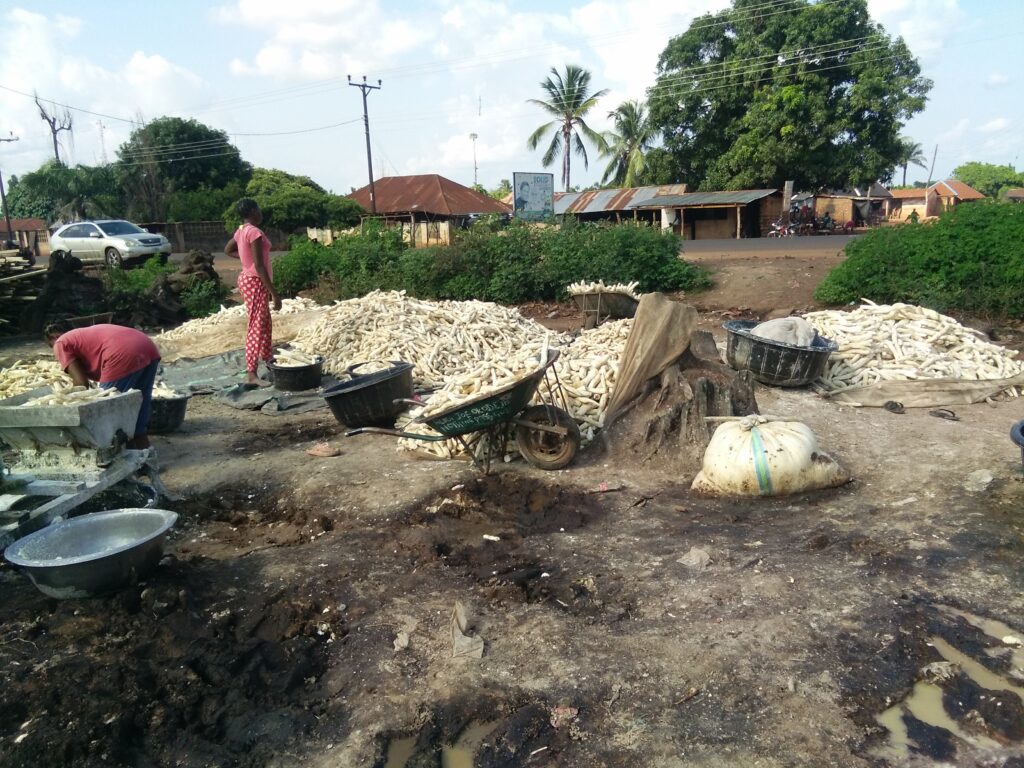
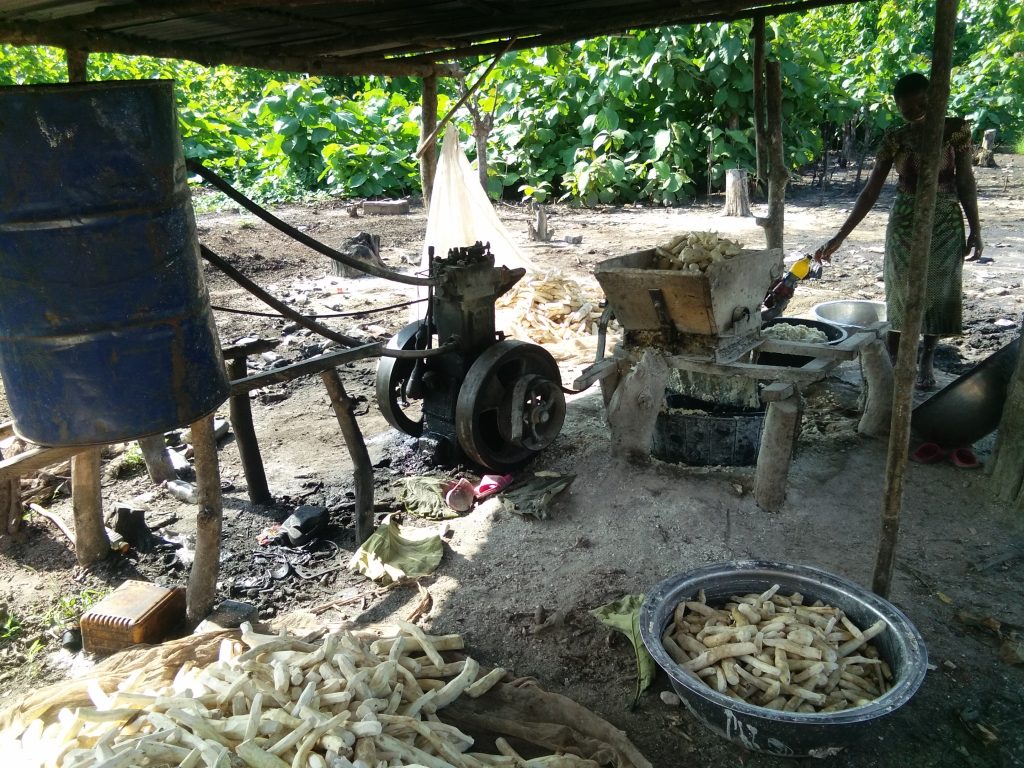
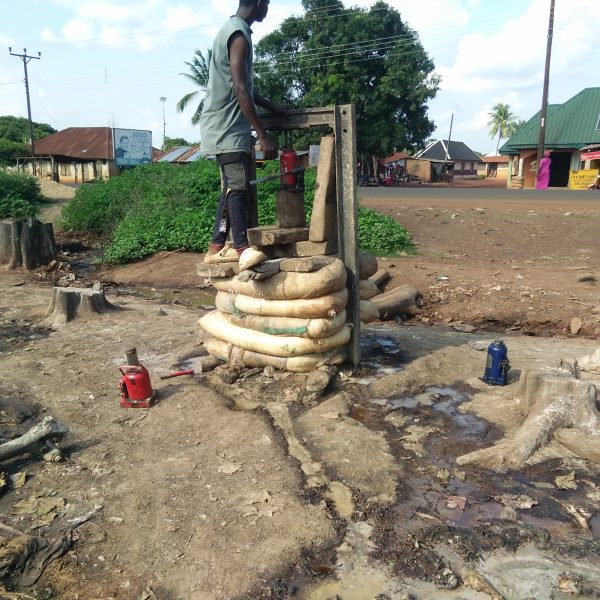
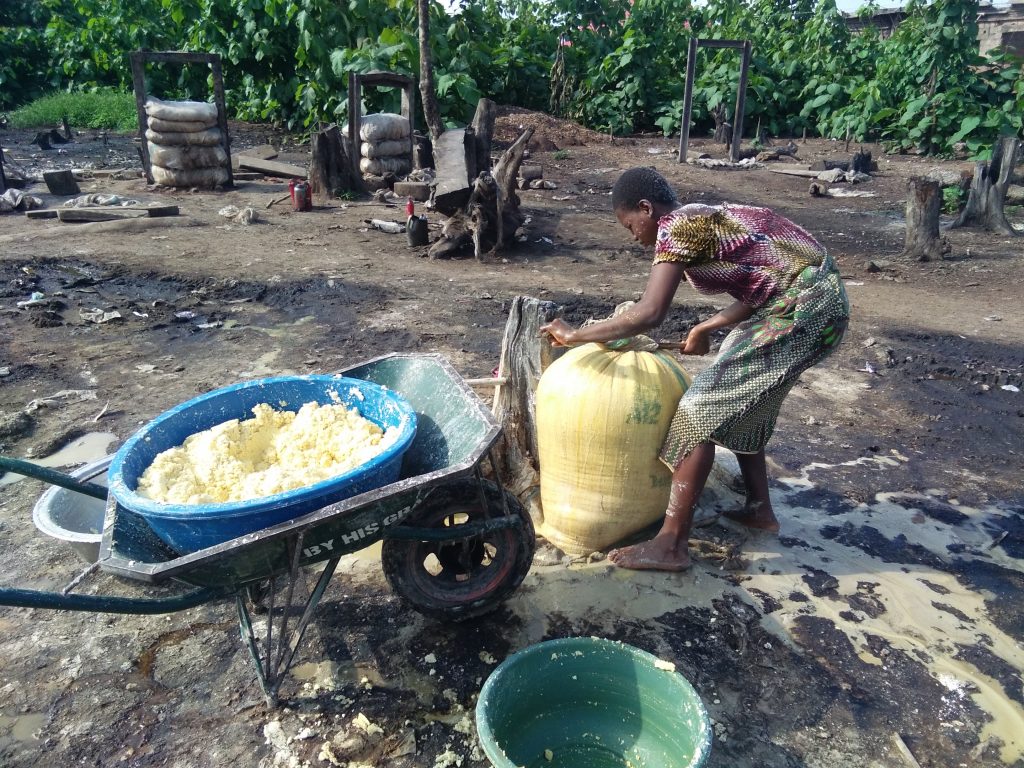
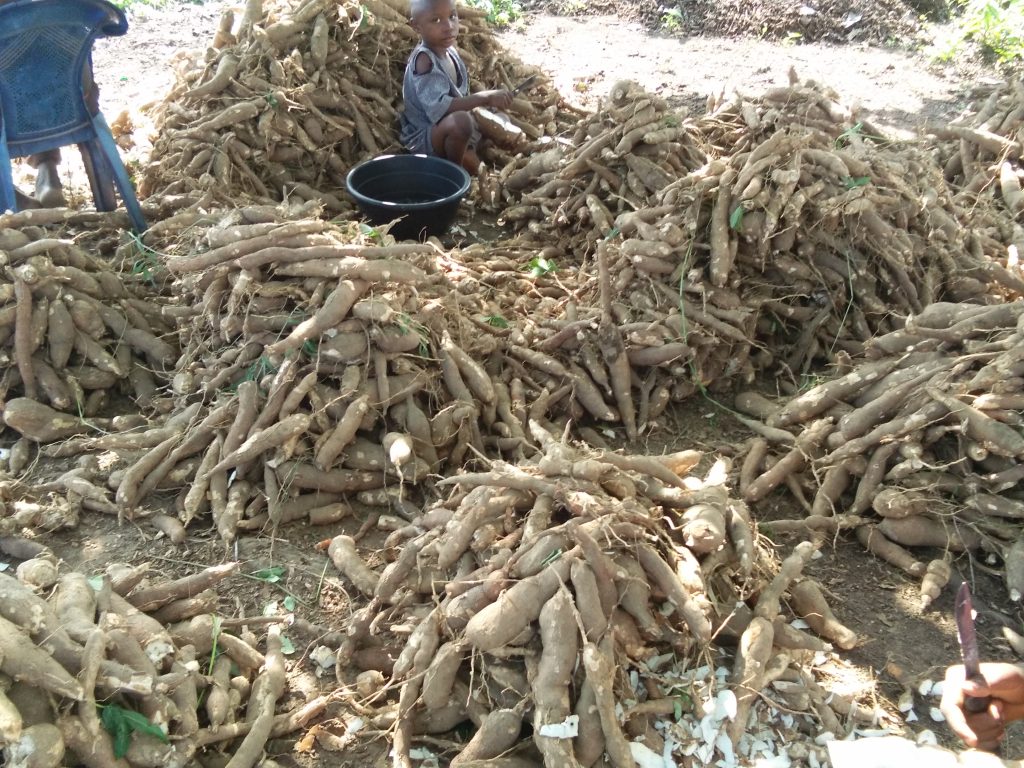
In the town of Ogobia (also known as Ogobia-Ugboju) in the Otukpo Local Government Area, evidences of this are everywhere. In almost 3 out of every 10 compounds people are involved in one form of activity or the other in the cassava processing value chain. Heaps of cassava are readily found in many strategic places surrounded by  a labour force of  women, girls and boys busily peeling them for upward processing. After peeling, the tubers are moved to to the machines  for grating. Thereafter the grated cassava are bagged and arranged in layers on pressers for hours for fermentation and  de-watering.

After thoroughly sifting the half-dried grated cassava by the diligent hands of another segment of the labour force of young boys and girls, the frying, another major task that requires a great level of diligence and patience, eventually takes place. A large rectangular iron tray of about 4ft by 5ft in size called agbada by the locals is used to fry the garri. These laborious activities often last well into the nights each day for each batch which take a couple of days to complete.


Since the frying is always well done (or “fry-done”) it does not require spreading for drying in the sun, which makes the “ogobia garri” very neat and stone-free. They are afterwards packed in basins and/or bagged for transportation to the local market where there are ready middle-men waiting to receive them. Many of the garri producers are fond of saying that “You may go to the market with a hundred bags of garri, but you’ll never return without selling all of them.”

A Mass Shift to Cassava Production and Processing as an Emerging Industry

With a landmass of 33,955 square kilometers and a population of over 6 million people (2022), Benue state is known as the food basket of the nation owing to the vibrant agricultural life of its people with the attendant generous food crop production. Located at the north-central area of Nigeria, the state’s main geological formations are sandy-loam shelf basement complex and alluvial plains. These together with its location in the transition belt between the north and south ecologies and a favourable rainfall pattern account for its support for a wide variety of crops which include yam, cassava, rice, beans, guinea corn, maize, soya beans, millet, potato, sorghum etc.


Most of the people of the state are farmers with rich cultural heritage that is typical of most Nigerian ethnic groups. Famed for their cheerful and hospitable disposition, the people are highly industrious, particularly in the agrarian sector which engage about 75% of the population. In the past, a farmer in an average community in Benue State, whether farming at mere subsistent level, semi-commercial level or at a full commercial level, an individual was not considered a serious farmer if yam production was not his/her major farming activities. In recent times, however, the age-long culture of yam farming among the people seem to have changed as attention is swiftly being shifted from yam production to cassava as the “new bride.”

Cassava is now so highly prized and sought after for production of garri, fufu (akpu) and lafu, whereas yam that used to be the most prized and farmed crop for commercial purpose, is now farmed mainly for personal consumptions. According to the local farmers, “The income generated from yam production is today nowhere near the income generated from cassava production when the acreage, labour and resources involved in the farming of both are compared.”


Opportunities and Challenges in Cassava Processing

In recent times the importance placed on cassava by value chain experts and the respect accorded it by the local farmers, who now recognize its immense potentials, is soaring. However, apart from the good income already being generated from it by the local producers through garri, akpu and lafu production, cassava’s other industrial uses for which it is in high demands in the international market are yet to be tap fully into.


For example, one major observation you make as you take a stroll around the town of Ogobia-Ugboju is that the environments suffer from both the heaps of cassava peels found in many places within the town and the strongly smelling waters pressed out of the fermented cassava grates. It is unfortunate, therefore, that these two major by-products of cassava which are themselves viable raw materials in the cassava processing value chain, are left as wastes either due to ignorance or due to lack of resources or due to the combination of both reasons.

The challenge of not finding real economic uses for cassava peels is not peculiar to Ogobia garri producers alone. The problems are common to most garri producing communities across Nigeria. Yet, in the entire cassava processing value-chain both the peels and the liquids are raw materials with high enormous economic potentials. If the locals are trained on how to turn the peels to feeds for poultry and ruminant farm animals at industrial scale, the industry will employ far more than it is employing now. Again, if these factories are equipped with modern equipment, the liquids pressed out of the cassava would be extracted for industrial starch production instead of constituting nuisance to the environment.

Means of transporting cassava from farm to the processing centres as well as moinMeans of transporting cassava from farm to the processing centres as well as moving the finished garri to the market is being eased by the use of tricycle trucks as the popular China-made agro-tricycle trucks are seen everywhere on major roads in Ogobia town. Loaded to full capacity these mini-trucks convey cassava from farms to the many “peeling centres” that are full of daily workers laboring from dusk to dawn to get the cassava peeled for its next stage in the production value chain. However, more can still be done for them transportation-wise by making more of these trucks and larger vehicles available to them at discounted or even subsidized rate so as to lessen the costs and burden of transportation. This done, it will act to make the prices lesser in the market for the retailers and final consumers.g the finished garri to the market is being eased by the use of tricycle trucks as the popular China-made agro-tricycle trucks are seen everywhere on major roads in Ogobia town. Loaded to full capacity these trucks convey cassava from farms to the many “peeling centres” that are full of daily workers laboring from dusk to dawn to get the cassava peeled for its next stage in the production value chain. However, more can still be made done for them transportation wise by making these trucks and similar vehicles available to them at discounted or even subsidized rate so as to lessen the costs and burden of transportation. This done, it will act to make the prices lesser in the market for the retailers and final consumers.

Another area that is posing great challenge to the women is the enormous manual labours involved. The women lamented over the tedious work of peeling the tubers.  It takes a lot of time and efforts to get a heap of cassava peeled. Many of the labourers come with their children to assist them so as to finish their quotas and meet deadlines. They are paid just N300.00 for each heap which takes hours to peel. Better and improved peeling tools and equipment, according to them, will introduce speed and efficiency thereby increasing daily outputs.


A major area in the entire process that the women said they need help is the frying section. The heat and smoke from the fire are almost unbearable and hazardous to their health. If an improved modern and health-friendly method of frying garri are made available to them many other women, girls and youths will be attracted to the industry and this will go a long way in improving their livelihood and creating more jobs.

Our Recommendation

Our track records at DPat Foundation show how passionately and vigorously we have being pushing for the economic empowerment of women and youths, especially at the grassroots levels. By organizing grassroots women into co-operatives we have helped to bridge the gaps that often exist between them and organizations that are saddled with the tasks of empowering enterprising women financially at the grassroots. In view of this, we recommend that relevant government agencies, private organizations, international organizations and individuals should look into ways by which grassroots women and youths in places like Ogobia-Ubgoju and other fast growing communities in Benue and other states in our great nation can be empowered. With the provision of modern equipment and other incentives this industry will grow and improve and more jobs will created at the rural levels.


On our part at DPat Foundation, we are on ground as a non-profit organization to organize these rural women into co-operative groups thereby making them accountable in the use of any facilities made available to them. 

READ MORE

COURTESY VISIT to GWAGWALADA AREA COUNCIL CHAIRMAN

DPat at GAC office
DPAT Foundation at the office of Alhaji Abubakar Giri, Chairman, Gwagwalada Area Council, FCT.

DPat Foundation has over the years being very vibrant in public relations endeavours under the leadership of its founder/president, Elder Mrs. Patience Ardey, who has repeatedly proven her mettle and capacity as a versatile leader who understands the need to carry stakeholders along each time the foundation carries out programmes that are meant to improve the community.


The president of the foundation feels a strong sense of accountability to not just the beneficiaries of the numerous grassroots programmes often carried out by the  foundation but also to community leaders and government officials as well. This strong sense of accountability and also the need to keep a vibrant reationship with relevant stakeholders prompted her visit to the chairman of the Gwagwalada Area Council Chairman, Abu Giri recently.

Dpat at GAC
Alhaji Abubakar Giri, Chairman, Gwagwalada Area Council of the Federal Capital Territory with the president of DPat Foundation(NGO), (4th from the left), the vice president of DPat Foundation (5th from the left) and other key members of the foundation, during the courtesy visit to the area council chairman,

During the visit, Elder Mrs. Ardey took time to give account of her stewardship, as the chief steward of the organisation, as she updated the chairman on the various past and present landmark achievements of DPAT Foundation and as well informed him of upcoming programmes that the foundation has scheduled for the year,

READ MORE

A REPORT ON ONE-DAY SYMPOSIUM ORGANIZED BY DPAT FOUNDATION (NGO)

A report by Elder Mrs. Patience Ardey (JP).

Dpat foundation, a non-governmental organization recently organized a symposium with the theme “WHY DO WE NEED TO TALK ABOUT NANO ENTREPRENEUR” at Gwagwalada Abuja. The event was attended by several government agencies such as National Directorate of Employment (NDE), Abuja Enterprise Agency (AEA), Agriculture Development Project (ADP), Bank of Agriculture (BOA), Agriculture and Rural Development Secretariat, FCT, Fadama Cares, Nigeria Police Force, Gwagwalada division, as well as various private sector organization such as Basic Response Multipurpose Cooperative Society, Poultry Farmers Association, Amoalukhe Women group, Ayedo Women group from Ibwa, Ayebwaka group, Wuna, Nassara Women Empowerment Group and several other dignitaries.

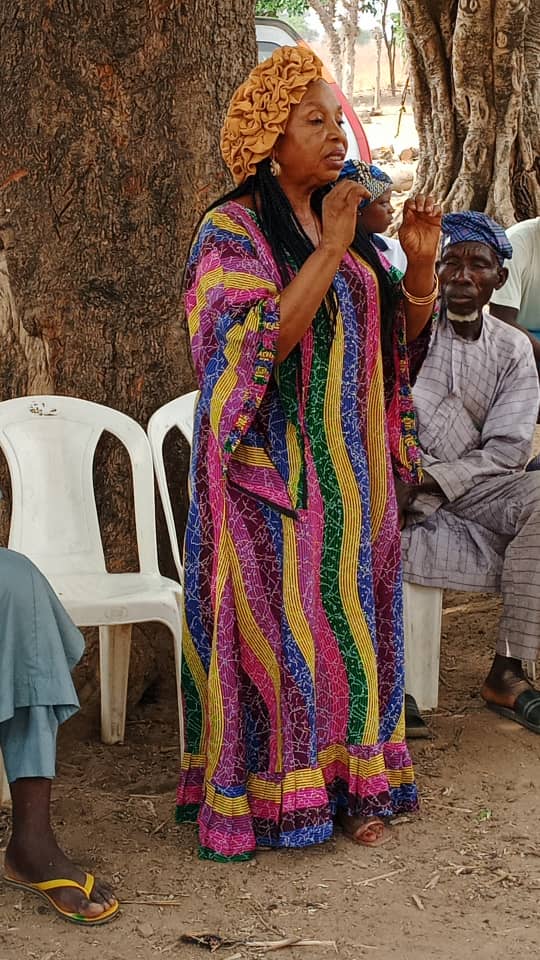
Elder Mrs Patience Ardey In her opening address at the symposium on nano enterprises in March, 2024

In her opening address, President of Dpat Foundation, Elder Mrs. Patience Ardey expressed profound gratitude to all partners and friends of the foundation both in the public and private sectors of the economy who have been very supportive of the foundation over the years. She specifically highlighted the role of NDE over the years as well as the AEA for the grant some members of the foundation have enjoyed from them.


Talking about the theme of the symposium, Mrs. Ardey defined Nano Entrepreneur as those traders and business men and women like akara sellers, Barbers shop, small roadside kiosks, masa sellers, pure water sellers, tomatoes and peppers sellers, etc that are not registered with corporate affairs commission CAC, yet are contributing to sustain households as well as families while contributing to the national economy silently but effectively. This group of entrepreneurs are very much neglected and overlooked by government agencies when it comes to accessing financial facilities and empowerment from government agencies and other bodies because they are not recognized by government and they are organized to be able to come together to access such facilities.

Speaking further, she stressed the need for more attention to be paid on this group of entrepreneurs, while also encouraging them to take advantage of platforms provided by organizations like Dpat Foundation. She said joining such groups will give them better opportunities to access such empowerment provisions made available by government agencies with such mandates from time to time.


 PROJECT 60

Elder Mrs Patience Ardey used the occasion to introduce Project 60 to all the participants.Project 60 is the educational arm of the foundation which seeks to provide scholarship to indigent but vulnerable children from poor communities and families.About 60 pupils in primary and secondary school from Ibwa II community in Gwagwalada area council of federal capital territory, who are the first beneficiaries of the scheme were presented at the occasion. The scheme covers their education from primary school to secondary school level. She said the foundation hopes to increase the number of beneficiaries in future. She thanked the chief of Ibwa II, Alhaji Abubakar Bamayi for his support and encouragement to the scholarship scheme.


Cross sections of children who are beneficiaries of the first batch of the Project60; the scholarship arm of DPat Foundation (NGO). Scholarship scheme

Yearly as more children, especially out of school children, will be picked and sent to school through this project every year. The President thanked and appreciated the Chief of Ibwa II, Abubakar Bamayi for the unshakable supports and encouragements and role he has provided to make the projects a success right from the day the idea was presented to him.

PAPER PRESENTATION

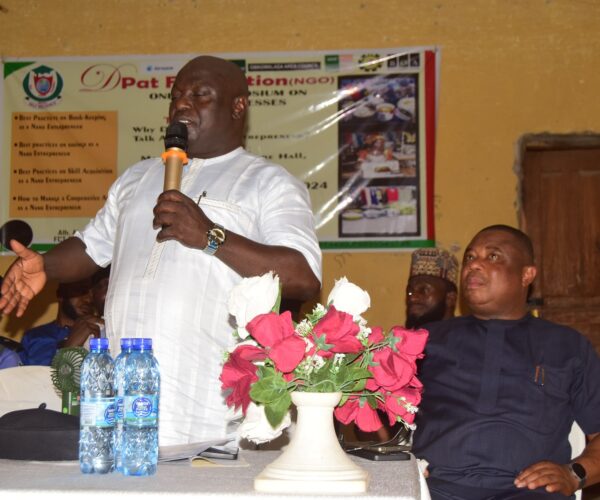
Mr. Bala Tsokwa from Abuja Enterprise Agency gave an interesting lecture on “simple book keeping for Nano business” where he emphasize the importance of proper financial records for small business owners. He said they should have sales record, purchase record, income records and inventory record.He emphasize on the need to keep daily records and strongly advised against giving out too much credit because it will affect the business badly.


An official of the Abuja Enterprise Agency (AEA), Bala Tsokwa giving lecture on Book Keeping.

Mr. Chimezie Noble, FCT State Coordinator of National Directorate of Employment in his lecture on financial management for small and Nano businesses added that there’s a need to be judicious and prudent in financial management as well as to be quality minded in service and product delivery so that there business can grow and be profitable.

Paper presentation by The FCT State Coordinator National Directorate of Employment (NDE), Mr. Chimereze Noble.

Mrs. Justina Ogwumelen from women in agriculture and representing the director, ADP, Dr. J. G. Omole emphasize on the need for Nano business to be intentional, disciplined and focused through hard work and strict financial discipline.

Mrs. Justina Ogwumelen, HOD, Women in Agric from the Agriculture Development Project (ADP), Representing the Director of ADP, Dr. Omole
An official representing the Director of Cooperative / FCTA, Mandate Secretary,Agriculture and Rural Development Secretariat

Mr. Ogbodo Somto and Mr. Ofem Obono representing the director of cooperative, FCTA mandate secretary, agriculture and rural development Secretariat in their speeches harped on the importance of Nano business owners to form or belong to cooperatives so that they can use the platform to leverage access to facilities from among themselves and from government agencies for their business growth.

Dr. John Horry, representing, Basic Response Multipurpose Cooperative Society Addressing the audience at the symposium.
An interpreter interpreting the lectures in local languages for grassroots members of audience

Dr. John Horry of Basic Response Multipurpose Cooperative Society gave a talk on the importance of detoxification and weight loss. He also used the occasion to introduce an innovative organic fertilizer that can be of immense benefits to farmers by increasing crop yields. According to him the organic fertilizer is to be applied to crops or to the soil after mixing a very small quantity with water. He said the fertilizer will be sold at affordable rate to farmers in partnership with Dpat foundation.


A major high point of the day was a slide presentation of the activities of Dpat foundation and a brief history of the organization. Some of the businesses that benefited from AEA grants through Dpat foundation were highlighted and some of the beneficiaries were also present to exhibit their products which ranged from catering, fashion design, schools, pharmaceutical, plumbing materials and solar panels/installation.

Photos from the Exhibitions During the Symposium

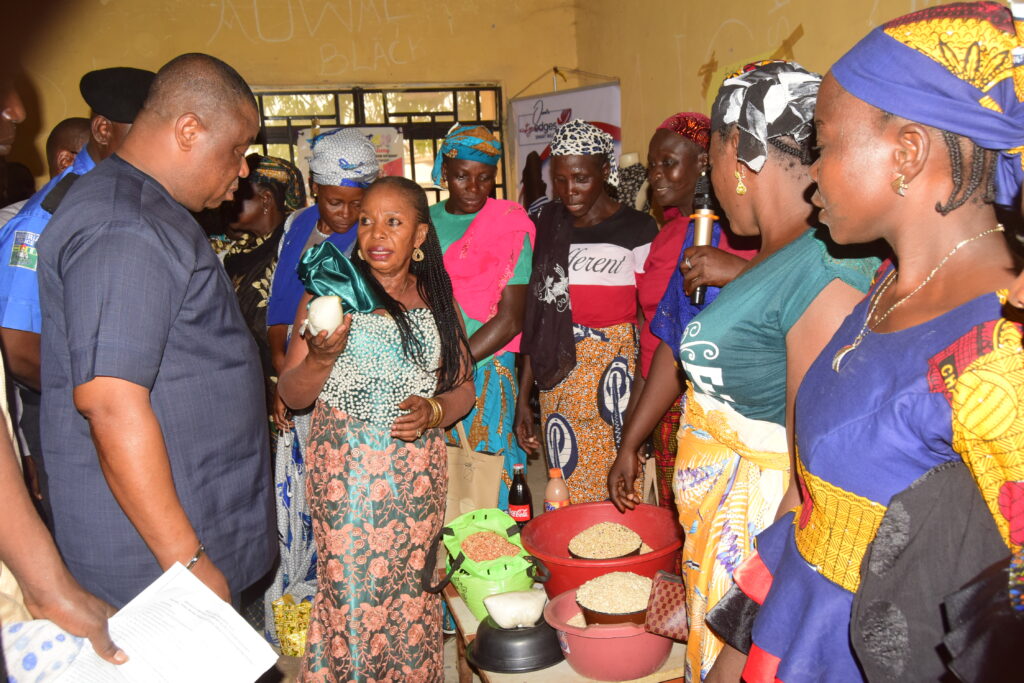
A beneficiary of the AEA grants at her exhibition stand being inspected by The FCT State Coordinator National Directorate of Employment (NDE), Mr. Chimereze Noble and other guests.
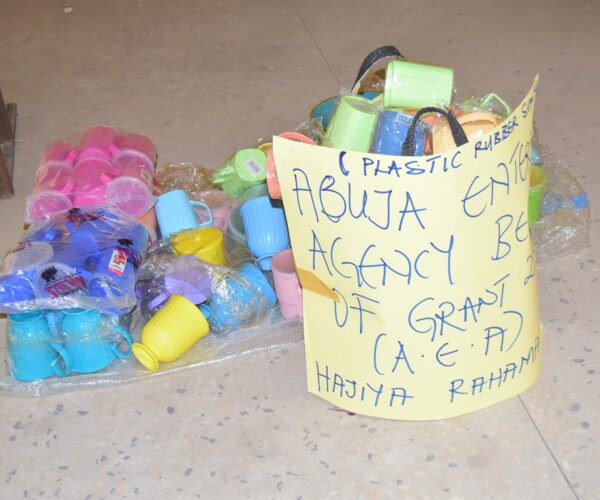
Exhibitions stand of one of the beneficiary of the AEA grant.
Exhibitions stand of some of the beneficiaries of the AEA grant.
Some of the guests at some exhibition stands of the AEA grants beneficiaries.
A beneficiary of the AEA grants at her exhibition stand giving a word of appreciation to AEA.
More exhibitions stand being inspected by guests.
More grants beneficiaries openly appreciating AEA while their products on display are being inspected by guests.
Produce samples been displayed by grassroots women at the exhibitions.
READ MORE

WHY DO WE NEED TO TALK ABOUT NANO ENTREPRENEURS?

Nano ent symposium
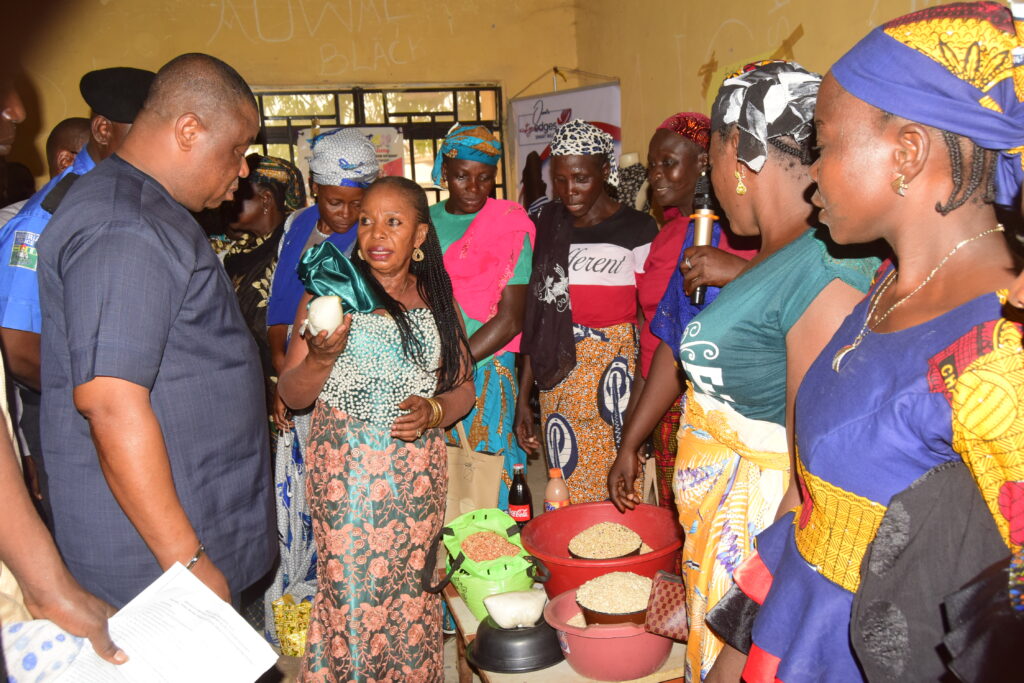
Elder Mrs. Patience Ardey conducting guests at the exhibition stands of grassroots women during the symposium

Nano Entrepreneurs are those traders and business men and women who fall within a distinct segment of the micro, small and medium scale enterprises (MSMEs). These distinct groups have been recognized to be a very strong force that contribute immensely to national economy. Nano businesses usually comprise of one person and at the most, two people,  (usually the business owner and an assistant or help who is more or less the only employee apart from the owner). In Nigeria, businesses are classified according to the numbers of workers in the business as:

  1. Nano (1-2 people),
  2. Micro (3-9 people),
  3. Small (10 to 49),
  4. Medium (50 to 199),
  5. Large (200 and above).

Nano businesses make up a very large portion of the entire population. A very high percentage of working age Nigerians, especially women, are involved in nano entrepreneurial activities. These include roadside kiosks and shops operators, roadside makeshift shades and market women as well as numerous others who hawks their wares on the streets selling akara, masa, okpa, pure water, pepper  etc. Nano enterprises are the very heartbeats of  the informal sectors, contributing to sustain households while contributing to the national economy silently but effectively. This group of entrepreneurs do not often have the opportunities to access  facilities for empowerment from government agencies and other bodies because they are enough organized   together to form a common front to access such facilities.


President, DPat Foundation, conducting guests at the rural women's exhibition stands

As one who has been in the forefront of women, girl-child and youths empowerment via skills acquisitions, Elder Mrs. Patience Ardey is making major moves to help fill the gap through concerted efforts geared towards empowering rural women, girls and youths by providing skills acquisition training through the DPat Foundation (NGO) platform.Beyond these skills empowerment efforts, she also realized that platforms should also be provided through which the beneficiaries of the skills empowerment can have the serachlight beamed on them so that the relevant authorities can get to notice their challenge and come to their rescue by way of providing them the facilities that would enable them take their businesses to a better level of economic viability.


One of such moves was the recent symposium held in Gwagwalada on the 29th of February, 2024, organized by DPat Foundation (NGO). The theme of the symposium was “WHY DO WE NEED TO TALK ABOUT NANO ENTREPRENEURS?” The symposium drew guest from various government agencies like the National Directorate of Employment (NDE), the Abuja Enterprise Agency (AEA), Agricultural Development Project (ADP), Fadama Cares, Bank of Agriculture (BOA), Agriculture and Rural Development Secretariat as well as numerous other private sector organisations and women groups.

Nano business exhitions
One of the beneficiaries of the AEA grants exhibiting her products during the One-Day Symposium on nano entrepreneurs

Another efforts at ensuring that nano entrepreneurs and not neglected is the ongoing grants being giving to nano businesses through DPat Foundation (NGO) by the Abuja Enterpries Agency (AEA). Two batches of those who applied for the grants have received the grants. The third batch will soon receive their own. DPat Foundation also has vibrant and functional co-operatives that also carter to the needs of nano businesses.  These co-operatives are open to members of the public, especially nano business owners.

A beneficiary of the AEA grants at her exhibition stand being inspected by the guests.
Grassroots women displaying their produce samples at the exhibition stands
READ MORE

Official Visit to Our Partner, AEA, for Strengthening of Relationship

AEA VISIT Dpat official visit to our partner for strengthening of Relationship today 19/03/2024
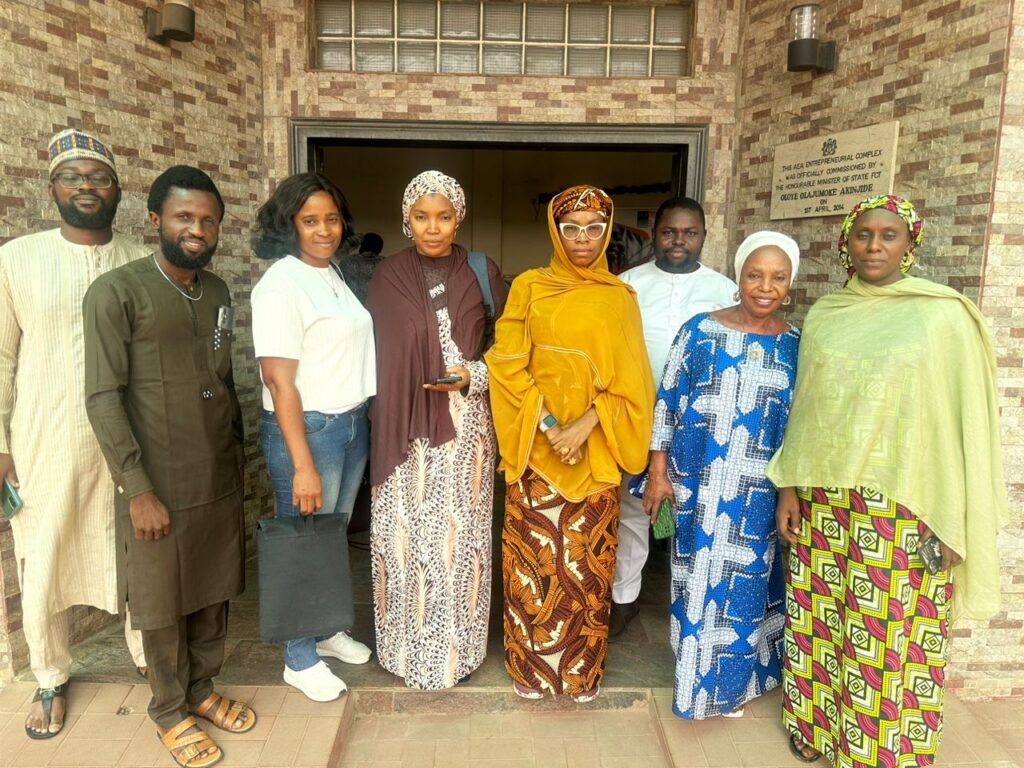
The President of DPat Foundation, Elder Mrs. Patience Ardey (2nd from the right) and some of the officers of the foundation as well as staff members of AEA in group photograph at AEA premises shortly after the visit.

We have come a long way in our working partnership with the Abuja Enterprise Agency (AEA). On Tuesday, 19th of March, 2024, we paid an official visit to the agency for the purpose of strengthening this vibrant and impactful relationship. This official visit to the agency was, in part, meant to also show our gratitude to them for the massive supports they gave to us during our recent One-Day Symposium on nano entrepreneurs.


The visit also afforded us the opportunity to express our profound gratitude for the grants given to our members by the agency. The grants which are in three batches have, as at today, reached our members in two batches and have immensely helped to enhanced the beneficiaries’ businesses. The third batch is on the way.

READ MORE